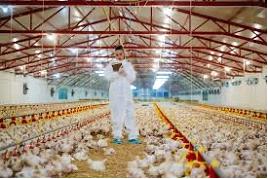
 The Agency for Food and Environment and Occupational Health and Safety (ANSES) for France has recommended preventive immunization of “poultry professionals” with the available human seasonal influenza vaccine. The purpose is to limit the possibility of a recombinant event should individuals infected with the current prevalent H3 strain of human influenza come into contact with either wild birds or commercial poultry infected with H5 virus.
 The advisory was circulated in recognition of the high incidence rate of avian influenza among commercial farms in addition to more frequent isolation from migratory birds. The ANSES recommendation should however have encompassed all workers and managers coming into contact with live poultry including those employed on farms, in transport and processing and should not have been limited to “professionals.” It is emphasized that there have been no diagnosed cases of H5 infection among poultry workers in France.
The Agency noted the extension of H5N1 to mammalian species including foxes and an otter, suggesting the risk of an emergent zoonotic strain of H5N1 with contagion or a recombinant arising from contact between individuals infected with human influenza and wildlife or poultry infected with HPAI. The advisory is a component of a preventive strategy to limit the remote possibility of a recombinant event at the human-animal interface.
CHICK-NEWS has consistently advocated for routine influenza vaccination of all workers and managers in the poultry industry since the advent of the current HPAI epornitic during late 2020. It is regrettable that the seasonal human influenza vaccine does not contain H5 antigen. Unfortunately the H3 antigen in the 2025 trivalent vaccine provides minimal protection against infection with the current circulating strain.
 The policy of the Department of Health and Human Services (HSUS) spearheaded by Robert F Kennedy Jr. has been to deprecate the value of mRNA vaccines through unscientific and unsubstantiated comments. In addition the HSUS has deprived academic and commercial institutions of funding for mRNA vaccine research. This will place our Nation at a disadvantage should H5N1 emerge as a zoonotic infection. Many institutions and commercial laboratories are close to developing broad spectrum mRNA vaccines against diverse influenza strains. The technology offers the advantage of rapid manufacture in the event of a human epidemic. Traditional egg-propagated vaccine requires at least six months to prepare in volumes adequate to address an extensive regional or national outbreak.
As an extension to the ANSES recommendation, should U.S. health authorities consider offering H5N1 immunization of poultry industry workers including crews depopulating farms and health professionals using commercially available vaccine prepared and stockpiled in the U.S.? Finland has initiated a program to protect farmers and workers in contact with poultry and mink using available vaccine.