A recent molecular evaluation was conducted on H5N1 isolates collected from workers involved in depopulation of infected flocks in Washington State during late October and early November 2024. Over the period April 2024 through June 2025 70 human cases of H5N1 infection were documented. These included 41 cases after exposure to infected dairy herds infected with genotype B3.13. A total of 24 cases followed exposure to infected commercial flocks infected with D1.1 genotype, with two cases following exposure to backyard flocks and three cases with an unknown source.
Extensive studies were conducted by the Centers for Disease Control on virus isolated from eight adult workers demonstrating conjunctivitis and mild respiratory symptoms. Virus was detected applying PCR. Sequencing was completed on the neuraminidase gene of H5N1 on five cases and from the neuraminidase gene from four cases.
 Virus was propagated on MDCK cells and in embryonated eggs. All isolates were characterized as HPAI H5N1 clade 2.3.4.4b genotype D1.1. There were no changes in the genome known to be associated with adaptation to mammalian cells or related to increased infectivity for, or contagion among humans. The isolates obtained from workers in Washington were compatible with avian alpha 2,3 sialic acid receptors.
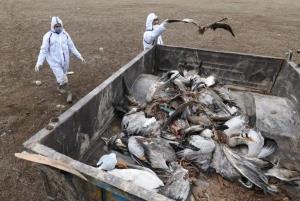
Notwithstanding the absence of genetic markers associated with zoonosis, it was recommended that ongoing surveillance and evaluation of clade 2.3.4.4b viruses is necessary to detect mutations that may be precursors of the emergence of a zoonotic strain.